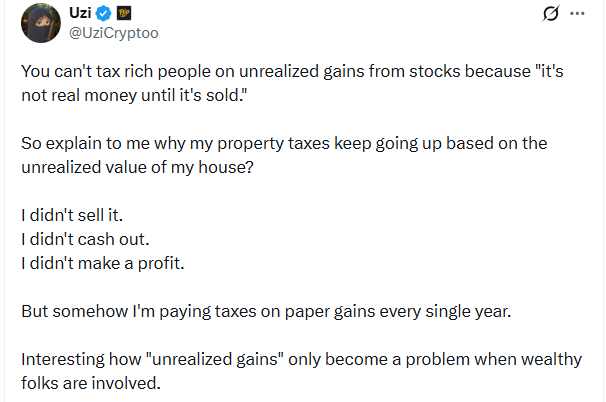
VetOfTheSeas@discuss.online to Work Reform@lemmy.world · 1 month agoThe rich convinced us that taxing them is too complicated but everyday people can be taxed pretty easilydiscuss.onlineimagemessage-square192linkfedilinkarrow-up11.7Karrow-down114
arrow-up11.68Karrow-down1imageThe rich convinced us that taxing them is too complicated but everyday people can be taxed pretty easilydiscuss.onlineVetOfTheSeas@discuss.online to Work Reform@lemmy.world · 1 month agomessage-square192linkfedilink
minus-squarealmost_genocide@lemmy.worldlinkfedilinkarrow-up1·1 month ago Securities would not be considered “real property”. I’m not interested in what billionaires would consider “real property”. Stocks are property.
minus-squareRivalarrival@lemmy.todaylinkfedilinkEnglisharrow-up1·1 month agoI see. How does that particular distinction affect this discussion?
minus-squarealmost_genocide@lemmy.worldlinkfedilinkarrow-up1·1 month agoThis is me pointing to the headline. “The rich convinced us that taxing them is too complicated but everyday people can be taxed pretty easily” Stocks are property. Easy.
minus-squareRivalarrival@lemmy.todaylinkfedilinkEnglisharrow-up1·1 month agoMaybe I’m an idiot, but I am just not understanding the ramifications of your argument. Yes, Stocks are property. They are a specific type of property: “intangible personal property”. That type of property is not currently taxed. I am describing a method in which that type of property will be taxed. What does your distinction bring to the discussion?


I’m not interested in what billionaires would consider “real property”.
Stocks are property.
I see. How does that particular distinction affect this discussion?
This is me pointing to the headline.
Stocks are property. Easy.
Maybe I’m an idiot, but I am just not understanding the ramifications of your argument.
Yes, Stocks are property. They are a specific type of property: “intangible personal property”.
That type of property is not currently taxed. I am describing a method in which that type of property will be taxed.
What does your distinction bring to the discussion?